
Fitness for artists
I’m going to note my thoughts on keeping my body and mind fit to create and how I do it, I’m going to come back to this and build on it, when I have time, watch this space…
How do you sit?
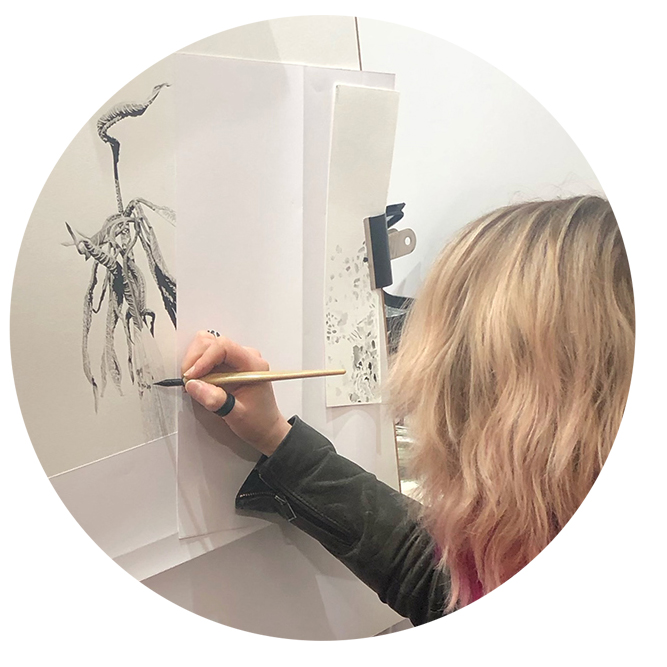
I spent a few years working bent over a board with blocks to prop it up on, and eventually my back complained. My fantastic osetopath, Helen How, took one look at me on first meeting and proclaimed me a designer/artist; she had seen this problem so many times, I didn’t even need to open my mouth. She encouraged me to find a setup that would allow me to sit back in my seat instead of leaning forward, so I had a bit of an investigation. I felt that an easel might be the thing, but I couldn’t imagine how to deal with the positioning of my specimens and lights, or how to keep my hand steady enough in a standing position, until I discovered the fabulous table easel.
I have a couple of them now. I have easels that fold up and are transportable like a small briefcase. These are great if you need to store them and also for taking to classes. I also have an extremely light-weight fold-out metal version, which I can take abroad; it weighs very little and folds up into a small tube, come to think of it, it’s so small that I’m not sure where it is!!!
I use boxes (small boxes of varying sizes) underneath the easel, so that I can lower or lift the painting or illustration to suit my seating position. I also have a chair with an adjustable height. The table easels that I have can accommodate quite large pieces; I’ve worked on 80cm sheets with ease.
I also use a folded pillow on my lap, and this allows me to rest my elbow to give me stability, although I often have a cat curled up on the pillow… I then rest on the cat.
I was recently teaching a class, and a participant was amazed to see me working wet on wet in a fairly upright position. TBH I hadn’t even questioned the process. I have been working this way for so long that I now just know how much water to use and how to move the paint so that I get the pigment where I want it to be. But this was an eye-opener for her, and I hope that she has success working in a more comfortable position.
How do you work? What is your setup?
Positioning your specimen
I like to position my specimen so that the mid section of it sits at my natural eye height, to the left of my easel. I try to position them pretty close to me, so that I don’t have to turn my head too much, and I’m not looking down.
Do you take your body into consideration when you position a specimen?
How do you breathe?
I have been practicing meditation for years now, I started off with a 40 minute Jon Kabat Zin practice, but now I do about 10 to 15 mins a day most days. and one of the gifts I have from this is good breath control, I can breathe deeply and slowly. This is fantastic when you are working at your easel. I continue to breathe as I work, I don’t find myself holding my breath as I complete tricky parts of my illustrations, and I can, most importantly, keep the oxygen flow to my brain and to my body as a whole.
Do you nitice your breath while you are working, do you breath fast, in a shallow way, do you fill your lungs, do you use your breath to keep your core strong and upright?